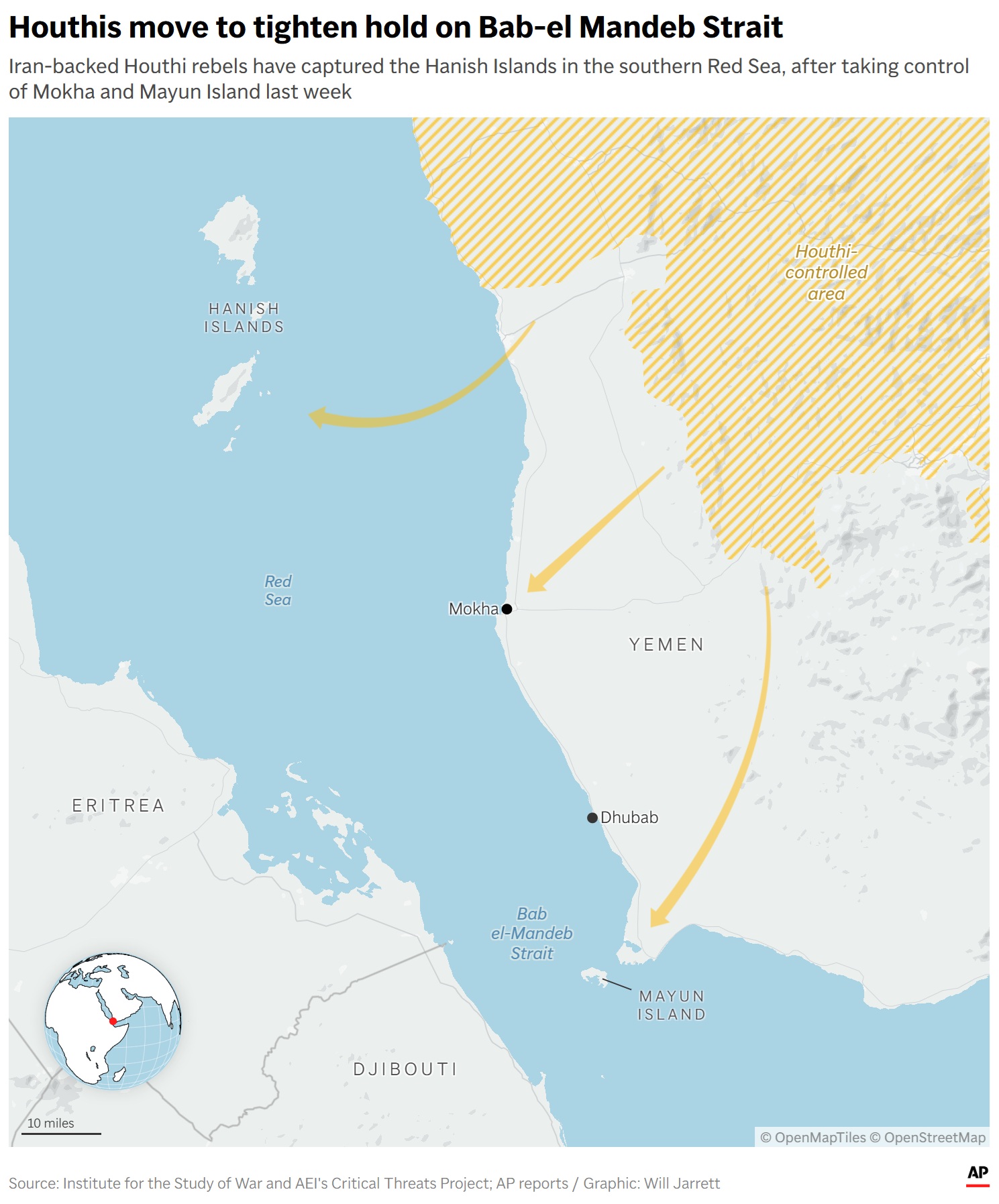
DUBAI — Maritime security dynamics in the southern Red Sea have deteriorated sharply following reports that Houthi rebel forces have seized control of two strategic, uninhabited islands positioned along international shipping corridors near the Bab-el-Mandeb strait. The territorial maneuver represents a calculated expansion of maritime projection capabilities, escalating concerns among international naval coalitions and commercial shipping cartels operating along the vital Europe-Asia trade route.
According to regional naval monitoring agencies and satellite intelligence analysts, Houthi military units deployed fast patrol boats and amphibious detachments to establish fortified observation posts and radar installations on the islands. The move provides regional forces with elevated line-of-sight monitoring over commercial traffic navigating the narrow transit chokepoint, through which roughly 12% of global seaborne trade traditionally passes.
Strategic Implications for Red Sea Navigation
The positioning of coastal radar, anti-ship missile batteries, and reconnaissance drones on offshore islands significantly compresses reaction times for commercial vessels and allied defensive escorts. Maritime defense analysts point out three critical operational ramifications:
- Chokepoint Surveillance: Direct electronic surveillance over both northbound and southbound traffic lanes entering the Bab-el-Mandeb strait from the Gulf of Aden.
- Asymmetric Interdiction: Enhanced capability to deploy uncrewed surface vessels (USVs) and sea mines from concealed anchorages closer to international shipping lanes.
- Insurance and Freight Escalation: Surging war-risk insurance premiums for commercial carriers, forcing container lines to prolong detour routes around Africa's Cape of Good Hope.
| Operational Metric | Standard Red Sea / Suez Route | Cape of Good Hope Diversion | Net Variance |
|---|---|---|---|
| Transit Duration (Asia to North Europe) | 25 - 28 Days | 37 - 42 Days | +10 to 14 Days Delay |
| Fuel Consumption per Voyage | ~1,800 Metric Tons Bunker | ~2,600 Metric Tons Bunker | +40% to 45% Fuel Consumption |
| Average Container Spot Rate (FEU) | $1,600 - $2,200 | $4,800 - $6,500 | +150% to 200% Cost Increase |
| War Risk Insurance Surcharge | 0.1% of Vessel Value | Negligible (Avoids Danger Zone) | Risk Avoidance Trade-off |
Diplomatic and Coalition Responses
International maritime coalitions, led by Western naval task forces, have intensified reconnaissance patrols across the southern Red Sea basin. Naval spokespersons affirmed that coalition forces maintain a robust presence to protect freedom of navigation, warning that unprovoked attacks against commercial shipping will encounter proportionate defensive counter-strikes against coastal radar and launch infrastructure.
Concurrently, regional diplomatic envoys in Riyadh and Muscat have renewed calls for restraint, cautioning that unchecked maritime confrontations risk unraveling fragile ceasefire negotiations and further disrupting regional humanitarian relief corridors. UN maritime officials have called for an emergency meeting of the International Maritime Organization (IMO) to assess vessel safety protocols.
Long-Term Economic Repercussions for Global Supply Chains
Prolonged maritime disruptions in the Red Sea continue to exert ripple effects throughout global manufacturing and retail supply chains. Port congestion across European hubs has increased, while inventory holding costs for retailers have escalated due to transit volatility. Economists warn that persistent shipping cost inflation threatens to undermine global disinflation trends, underscoring the urgent necessity of restoring maritime stability along key international waterways.
Frequently Asked Questions
A: The Bab-el-Mandeb is a narrow maritime chokepoint between Yemen on the Arabian Peninsula and Djibouti/Eritrea in the Horn of Africa. It connects the Gulf of Aden to the Red Sea and the Suez Canal, handling over 12% of global seaborne commerce.
A: Rerouting around Africa adds 10 to 14 days to transit times, significantly increases fuel consumption, creates container supply imbalances at ports, and sharply increases freight and insurance costs.
A: Coalition task forces are conducting active maritime escorts, intercepting incoming drones and missiles, and deploying airborne surveillance to safeguard commercial transit lanes.
Asymmetric Warfare, Autonomous Unmanned Systems, and Defense Industrial Base Scaling
Modern military doctrine across Eastern Europe, the Middle East, and Southeast Asia is undergoing its most profound structural transformation since the advent of precision-guided munitions. Defense ministries from London and Washington to Kyiv and New Delhi are rapidly reorganizing both force structure and industrial procurement around a central battlefield reality: low-cost, AI-enabled unmanned aerial systems (UAS) and long-range loitering munitions now dictate tactical tempo along contested frontlines.
In the United Kingdom and Ukraine, bilateral defense-industrial co-production frameworks have moved beyond legacy stockpile donations toward joint intellectual-property licensing and decentralized assembly factories. By dispersing composite airframe fabrication, optical navigation assembly, and electronic warfare (EW) hardening across multiple secure industrial parks, defense planners mitigate the vulnerability of centralized manufacturing hubs to asymmetric sabotage or long-range strike threats.
Concurrently, Western army staffs are phasing out standalone, overly bureaucratic experimental drone detachments in favor of embedding organic FPV (First-Person View) strike and reconnaissance platoons directly into every infantry battalion and armored brigade. Rather than treating unmanned systems as a niche specialty controlled by rear-echelon generals, modern tactical doctrine requires every squad leader to integrate real-time aerial telemetry with automated counter-battery fire.
| Defense & Strategic Domain | Operational Shift (2026 Doctrine) | Strategic & Industrial Implication |
|---|---|---|
| Unmanned Force Structure | Transition from centralized test units to organic brigade swarms | Reduces sensor-to-shooter kill chain latency below 90 seconds |
| Bilateral Co-Production (UK-Ukraine) | Joint licensing & dispersed manufacturing of long-range systems | Insulates supply lines from single-point industrial bottlenecks |
| Navigation & Guidance | AI optical terrain-matching & EW-resistant frequency agility | Maintains strike precision inside heavy GPS-denied electronic warfare zones |
| Industrial Base Protection | Counter-sabotage intelligence & physical air-defense perimeters | Safeguards domestic European aerospace and energetics facilities |
Electronic Warfare (EW) Countermeasures, Supply Chain Security, and Geopolitical Resource Corridors
As unmanned platforms proliferate across theaters ranging from Yemen's Marib basin to northern Myanmar's mineral corridors, electronic warfare and critical mineral supply chains have become decisive strategic battlegrounds. Because GPS-jamming and frequency-hopping spoofing blankets frontline sectors, next-generation autonomous drones increasingly rely on onboard computer-vision terrain matching (DSMAC) and fiber-optic tether guidance immune to radio-frequency disruption.
- Defense Factory Counter-Sabotage: European security services have established multi-tiered counter-UAS radar domes, strict supply-chain vetting, and cyber-airgapping around munitions and drone assembly plants.
- Decentralized Swarm Integration: AI-assisted target recognition allows a single operator to coordinate multiple reconnaissance and strike airframes simultaneously under heavy radio silence.
- Critical Mineral Geopolitics: Control over rare-earth dysprosium, terbium, and battery-grade lithium processing corridors directly impacts the manufacturing scalability of brushless electric motors and high-density flight batteries.
Related Prime Media Investigative Dispatches
Frequently Asked Questions (Editorial Briefing)
Q1: Why are militaries phasing out standalone experimental drone units?
Combat lessons demonstrated that isolating drones in separate experimental commands created slow bureaucratic approval chains. Modern armies now integrate autonomous reconnaissance and strike drones directly into every front-line infantry and armor unit.
Q2: How are European defense factories protecting against asymmetric sabotage threats?
Defense ministries have deployed short-range counter-drone radar, hardened cyber-physical industrial control systems, and distributed component manufacturing across multiple redundant sites.
Editorial Analysis & Fact-Checking by Sarah Jenkins (Senior Technology & AI Correspondent), Prime Media Global Desk.