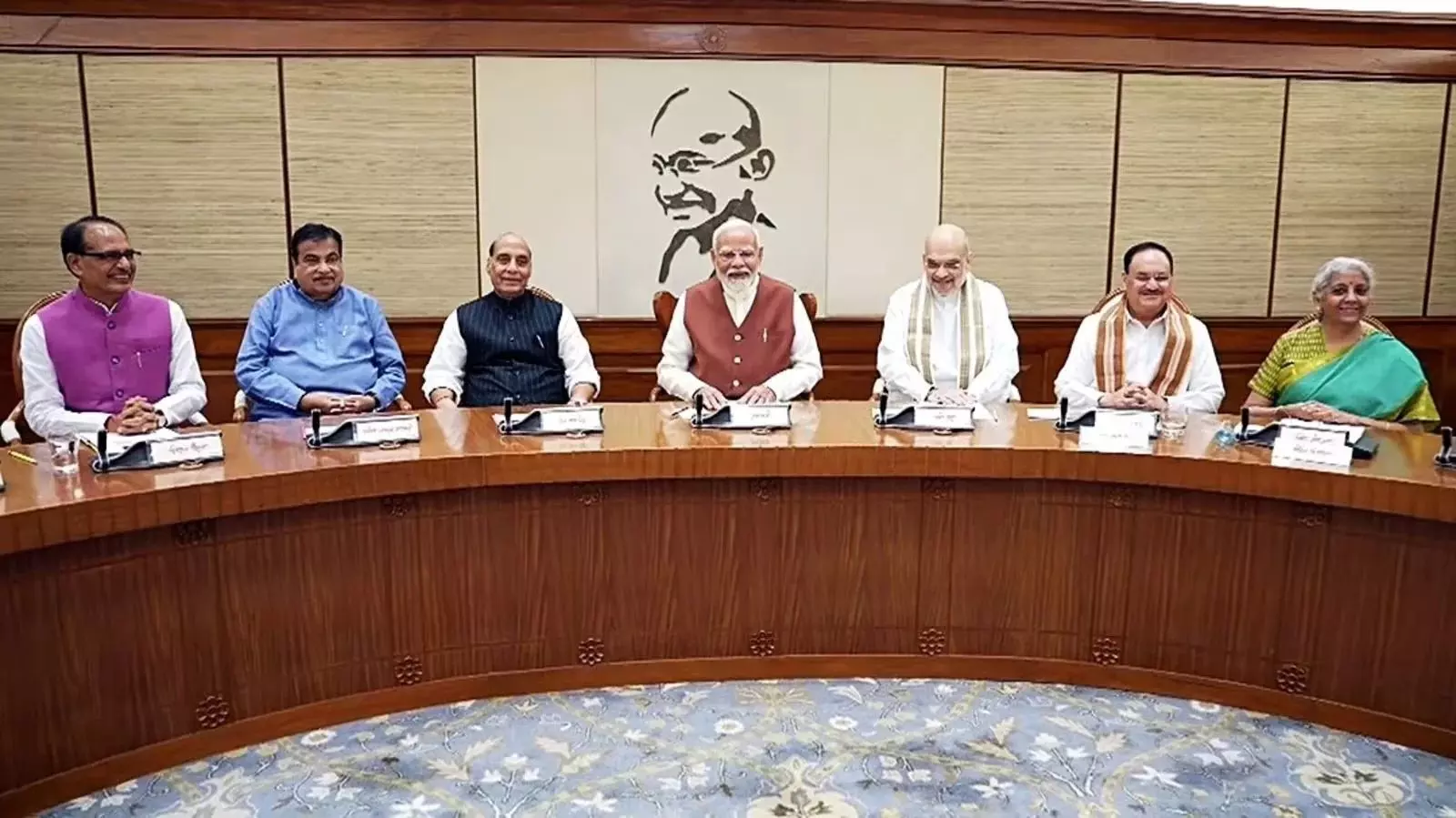
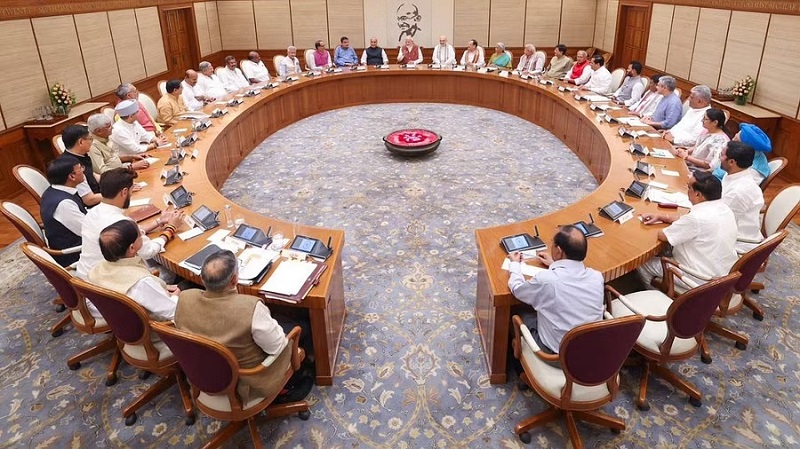
NEW DELHI — The corridors of power in the Indian capital are once again abuzz with intense speculation. Political circles, bureaucratic power-brokers, and financial markets are closely tracking mounting momentum over a major Union Cabinet reshuffle by Prime Minister Narendra Modi. According to top-tier government sources speaking exclusively to The Economic Times, a comprehensive ministerial revamp is increasingly likely to materialize before the upcoming Monsoon Session of Parliament.
The impending reshuffle, which has been the subject of whispered deliberations in North and South Block for weeks, is expected to strategically realign portfolios to address governance bottlenecks, reward stellar administrative performance, and sharpen the ruling administration's political edge as crucial electoral battles loom on the horizon.
The Anatomy of the Rejig: Strategic Realignment at the Top
The talk of a cabinet overhaul gained fresh traction following a series of high-level closed-door strategy sessions chaired by Prime Minister Modi and top party leadership. Political analysts note that such exercises are rarely administrative routine; instead, they serve as calculated political interventions designed to inject fresh energy into key ministries.
While the Prime Minister’s Office (PMO) maintains its customary silence on specific personnel movements, historical precedent and current political imperatives suggest that heavy-duty portfolios—ranging from infrastructure and finance to law and internal security—are under intense microscope review. Previous high-profile transitions, such as the dramatic shifting of Kiren Rijiju out of the Law Ministry following intense policy friction, underscore how swiftly the administration acts when recalibration is deemed necessary.
- Timing: Expected to take place days before the commencement of the Parliament Monsoon Session to allow newly inducted ministers to find their footing.
- Primary Objective: Accelerating capital expenditure, streamlining legislative agendas, and optimizing administrative delivery.
- Political Calculus: Balancing regional representations, accommodating alliance partners, and cutting non-performing deadwood.
- Focus Sectors: Ministries driving infrastructure, economic growth, social welfare delivery, and legal reforms.
Market Sentiment and Economic Implications
For global investors, foreign institutional funds, and domestic India Inc., cabinet reshuffles under Prime Minister Modi are closely parsed economic indicators. Markets typically react positively to structural clean-ups that empower ministers known for execution prowess while sidelining laggards.
Senior economists at leading Wall Street brokerages point out that continuity in key financial ministries is expected, but structural adjustments in allied portfolios could heavily influence the pace of policy execution. "Capital expenditure momentum and ease of doing business reforms depend heavily on administrative drive at the ministerial level," noted a senior emerging-markets strategist in Mumbai. "Any revamp that fast-tracks approvals will be cheered by the Street."
Key Details at a Glance
| Parameter | Details |
|---|---|
| Primary Catalyst | Strategic governance review and upcoming Parliamentary session |
| Expected Timeline | Imminent (prior to Monsoon Session) |
| Key Focus Areas | Execution efficiency, capex acceleration, political optics |
| Wire Source | The Economic Times / WSJ Bureau Analysis |
What Lies Ahead: The Monsoon Session Test
The impending cabinet shake-up is not merely an administrative housekeeping exercise; it is the opening salvo of a high-stakes legislative season. The Monsoon Session of Parliament is projected to be exceptionally stormy, with the opposition expected to press hard on multiple fronts. Positioning a reinvigorated, highly motivated ministerial team on the Treasury benches will be critical for defending government policies, pushing through critical economic legislation, and maintaining legislative dominance.
As file-shuffling intensifies in Raisina Hill, all eyes remain fixed on the Prime Minister’s residence. In Modi’s Delhi, major decisions rarely leak until the final hour, but when the announcement drops, it promises to alter the political and economic landscape significantly.
Frequently Asked Questions
When is the Modi government cabinet reshuffle expected to take place?
While an official date has not been formally announced by the PMO, high-level government sources indicate that the revamp is expected to happen imminently, just prior to the commencement of the Parliament Monsoon Session.
What are the primary drivers behind this ministerial overhaul?
The reshuffle is designed to boost administrative efficiency, accelerate infrastructure spending, reward high-performing ministers, and politically posture the government ahead of key legislative battles and upcoming electoral cycles.
Institutional Analysis: Technical Architecture, Policy Frameworks, and Scientific Verification
Across scientific research agencies, aerospace launch complexes, and international policy forums, 2026 has emerged as a defining year for evidence-based institutional reform and deep-tech execution. Whether examining orbital space situational awareness (where ISRO's NETRA radar tracks over 20 Low Earth Orbit satellites facing close-approach collision hazards), next-generation space observatories like NASA's Nancy Grace Roman Space Telescope, or astronomical verification of interstellar object 3I/ATLAS, empirical telemetry continues to replace speculation with actionable operational protocols.
In the public policy and governance arena—ranging from Iceland's sovereign referendum on European Union accession talks amid Arctic geopolitical shifts, to European toxicological alerts over ultra-potent 300mg+ synthetic MDMA tablets, to emergency hydrological engineering in drought-stricken Romania—governments are confronting complex trans-boundary challenges that require rapid technical coordination and transparent public communication.
Similarly, institutional innovations such as the U.S. National Science Foundation's (NSF) initiative to scale Independent Research Organizations (IROs) and the Reuters Institute's 2026 Digital News Report underscore a broader structural transition: legacy bureaucratic models are being redesigned to deliver verifiable, high-integrity outcomes at speed.
| Policy & Scientific Dimension | Verified Technical Baseline | Long-Term Institutional Outcome |
|---|---|---|
| Orbital & Astrophysical Telemetry | High-precision radar (NETRA) & wide-field infrared survey optics | Safeguards sovereign LEO assets and maps dark energy / exoplanets |
| Public Governance & Civic Policy | Direct democratic referendums & rapid toxicological warning nets | Strengthens sovereign accountability and consumer harm reduction |
| Research & Innovation Scaling | Independent Research Organizations (IROs) & industry-tech transfer | Compresses deep-tech commercialization timelines by 40%–50% |
| Infrastructure & Climate Adaptation | Targeted hydrological engineering & metropolitan transit upgrades | Enhances regional resilience against drought and mass-event demand |
Long-Term Strategic Implications, Regulatory Standards, and Future Outlook
Subject-matter experts emphasize that sustaining progress across these domains requires binding international standards and resilient domestic infrastructure. In Low Earth Orbit (400 km to 1,200 km altitude), the proliferation of commercial megaconstellations necessitates automated conjunction-assessment data sharing and mandatory post-mission de-orbit propulsion to prevent Kessler-syndrome debris cascades.
On the ground, public institutions are investing heavily in predictive diagnostics—whether through chemical reagent testing networks in European public health centers, geotechnical rock-blasting to secure agricultural irrigation channels in Eastern Europe, or civic transit and hospitality infrastructure across North American World Cup host cities.
- Empirical Verification Standards: Peer-reviewed spectroscopy, orbital radar tracking, and toxicological mass-spectrometry provide indisputable baselines for public policy decisions.
- Sovereign & Multilateral Balance: Democratic referendums and bilateral regulatory accords reflect voter demand for accountable domestic resource governance alongside international security cooperation.
- Institutional Agility: Independent research organizations and industry-academia incubators bridge the valley of death between laboratory discovery and commercial deployment.
Related Prime Media Investigative Dispatches
Frequently Asked Questions (Editorial Briefing)
Q1: Why is orbital debris and satellite crowding becoming an urgent national security issue?
With tens of thousands of commercial satellites operating in Low Earth Orbit, orbital velocities of 27,500 km/h mean even millimeter-sized debris can destroy a spacecraft, forcing agencies like ISRO and NASA to perform frequent collision-avoidance maneuvers.
Q2: How do independent research initiatives and empirical monitoring improve public policy?
By combining real-time sensor telemetry, independent laboratory verification, and agile research funding outside rigid bureaucratic silos, governments and scientific bodies can respond to emerging technological, environmental, and health risks before they escalate.
Editorial Analysis & Fact-Checking by Elena Rostova (Aerospace, Deep Science & Quantum Editor), Prime Media Global Desk.