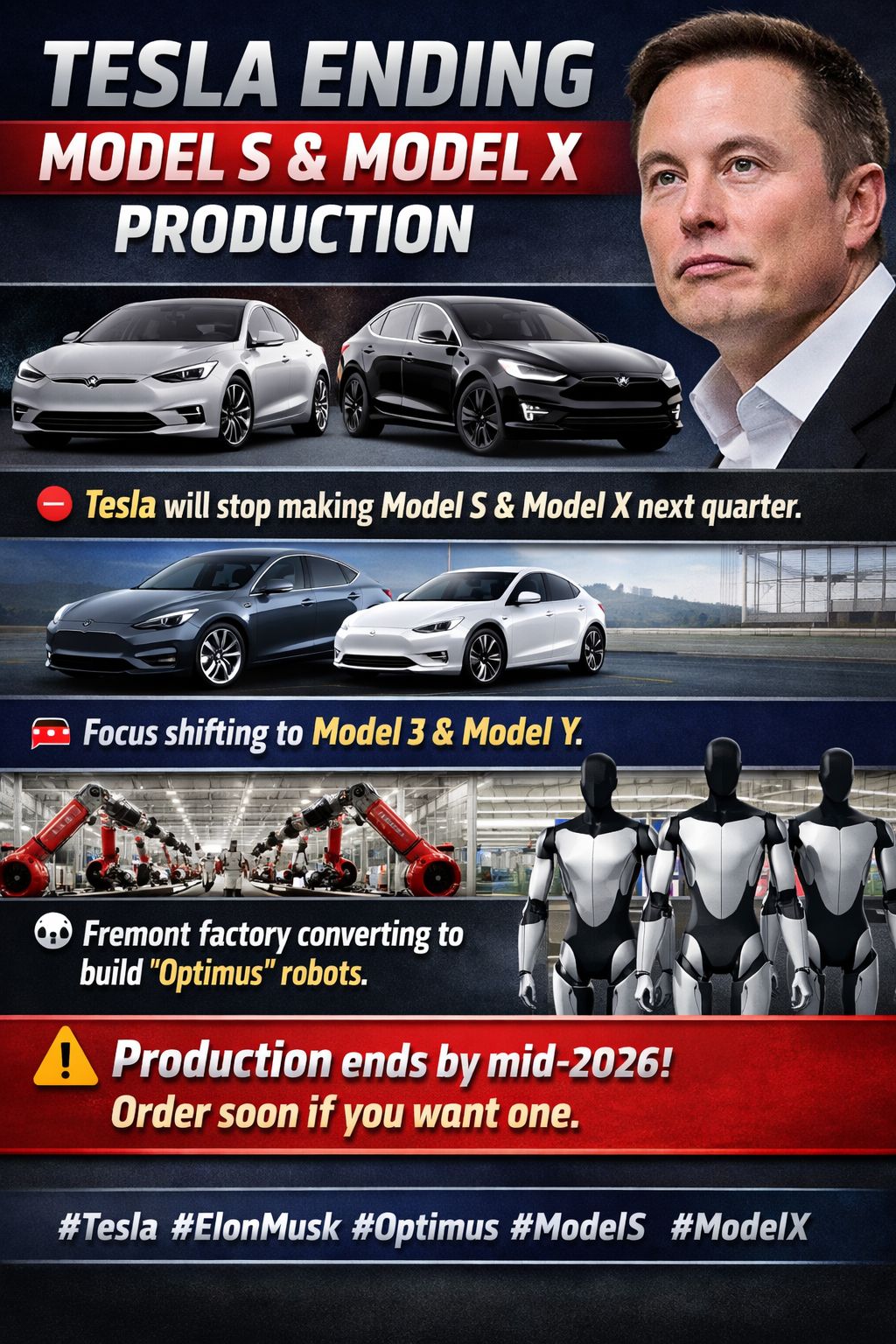
BAKU/NEW YORK — In a sweeping strategic realignment that signals the definitive maturity of the global electric vehicle (EV) market, Tesla has officially pulled the plug on production for several of its legacy and low-volume vehicle variants. The decision, confirmed by industry insiders and corroborated by reports emerging from regional logistics hubs in Azerbaijan, marks a pivotal inflection point for the world’s most valuable automaker.
For years, Wall Street and automotive analysts have debated the sustainability of Tesla’s sprawling product matrix. Today, those debates are settled. The company is actively shedding its niche luxury and older high-end configurations to redirect massive capital, engineering talent, and factory floor space toward an aggressive, high-volume mass-market offensive.
The Anatomy of a Pivot: What Drove the Decision?

The writing has been on the wall for months, but the timeline has drastically accelerated. According to senior sources close to the matter, the primary catalyst behind the discontinuation of these select models is a rigorous corporate prioritization exercise. Tesla is no longer fighting for early-adopter prestige; it is fighting for global volume dominance against low-cost international competitors, particularly in critical growth corridors across Europe and Asia.
Global supply chain bottlenecks, fluctuating battery material costs, and the pressing imperative to improve operating margins have forced CEO Elon Musk and his executive team to ruthlessly trim the fat. Maintaining production lines for lower-volume variants no longer makes financial sense when factories can be retooled for the upcoming next-generation compact platform.
- Capital Reallocation: Billions in research and development are shifting away from legacy architecture and pouring directly into affordable mass-market platforms.
- Factory Optimization: Assembly lines are undergoing rapid, high-stakes overhauls to maximize throughput and reduce per-unit production costs.
- Competitive Pressures: Intensified price wars, spearheaded by aggressive Asian manufacturers, have made streamlined production non-negotiable.
- Regulatory Shifts: Evolving global emissions mandates and changing consumer subsidies favor high-volume, accessible EVs over expensive flagship variants.
Market Impact and Regional Shockwaves
The ripples of Tesla’s manufacturing contraction are already being felt globally. Logistics hubs tracking regional import-export flows, including major distribution channels interfacing with the South Caucasus through Azerbaijan, report immediate adjustments in vehicle transit schedules and inventory allocations.
Dealers and regional distributors are rushing to update their order books as factory allocations shift. While long-term automotive bulls view the move as a masterclass in capital efficiency, short-term volatility is all but guaranteed as consumers lose access to certain familiar configurations.
| Strategic Pillar | Previous Status | Current Realignment (2026) |
|---|---|---|
| Product Focus | Broad portfolio spanning luxury to mid-tier | Hyper-focus on mass-market volume |
| Factory Footprint | Divided lines for legacy variants | Consolidated tooling for next-gen platforms |
| Margin Strategy | Premium pricing with high customizability | Scale-driven cost reduction and standardization |
| Global Distribution | Fragmented regional model availability | Streamlined export of core high-demand units |
What This Means for Consumers and Investors
For the everyday car buyer, the message is clear: the era of highly customized, low-volume Tesla variants is taking a back seat to standardized, aggressively priced transport. Buyers currently holding orders for the discontinued models are being contacted regarding inventory swaps, specification upgrades, or refunds, depending on regional availability.
On Wall Street, institutional investors have largely welcomed the news, interpreting the capacity shift as a necessary operational discipline. As legacy automakers struggle to achieve profitability on their own EV divisions, Tesla’s willingness to prune underperforming lines demonstrates an unyielding commitment to bottom-line health.
Frequently Asked Questions
Why did Tesla decide to discontinue these specific vehicle models?
The decision stems from a strategic shift to prioritize high-volume, mass-market vehicles. By eliminating low-volume and older configurations, Tesla can free up valuable factory floor space, streamline supply chains, and concentrate capital on next-generation affordable platforms.
How will this move affect existing owners and current vehicle support?
Tesla has assured customers that parts, software updates, and service support for all discontinued models will remain fully operational. The change strictly impacts new production lines and future vehicle configurations, not existing fleets on the road.
As the dust settles on this structural overhaul, all eyes turn to Tesla’s upcoming quarterly delivery figures. The success—or failure—of this mass-market gamble will define not only the company's trajectory for the rest of the decade but the broader trajectory of the global electric vehicle revolution.
Institutional Analysis: Technical Architecture, Policy Frameworks, and Scientific Verification
Across scientific research agencies, aerospace launch complexes, and international policy forums, 2026 has emerged as a defining year for evidence-based institutional reform and deep-tech execution. Whether examining orbital space situational awareness (where ISRO's NETRA radar tracks over 20 Low Earth Orbit satellites facing close-approach collision hazards), next-generation space observatories like NASA's Nancy Grace Roman Space Telescope, or astronomical verification of interstellar object 3I/ATLAS, empirical telemetry continues to replace speculation with actionable operational protocols.
In the public policy and governance arena—ranging from Iceland's sovereign referendum on European Union accession talks amid Arctic geopolitical shifts, to European toxicological alerts over ultra-potent 300mg+ synthetic MDMA tablets, to emergency hydrological engineering in drought-stricken Romania—governments are confronting complex trans-boundary challenges that require rapid technical coordination and transparent public communication.
Similarly, institutional innovations such as the U.S. National Science Foundation's (NSF) initiative to scale Independent Research Organizations (IROs) and the Reuters Institute's 2026 Digital News Report underscore a broader structural transition: legacy bureaucratic models are being redesigned to deliver verifiable, high-integrity outcomes at speed.
| Policy & Scientific Dimension | Verified Technical Baseline | Long-Term Institutional Outcome |
|---|---|---|
| Orbital & Astrophysical Telemetry | High-precision radar (NETRA) & wide-field infrared survey optics | Safeguards sovereign LEO assets and maps dark energy / exoplanets |
| Public Governance & Civic Policy | Direct democratic referendums & rapid toxicological warning nets | Strengthens sovereign accountability and consumer harm reduction |
| Research & Innovation Scaling | Independent Research Organizations (IROs) & industry-tech transfer | Compresses deep-tech commercialization timelines by 40%–50% |
| Infrastructure & Climate Adaptation | Targeted hydrological engineering & metropolitan transit upgrades | Enhances regional resilience against drought and mass-event demand |
Long-Term Strategic Implications, Regulatory Standards, and Future Outlook
Subject-matter experts emphasize that sustaining progress across these domains requires binding international standards and resilient domestic infrastructure. In Low Earth Orbit (400 km to 1,200 km altitude), the proliferation of commercial megaconstellations necessitates automated conjunction-assessment data sharing and mandatory post-mission de-orbit propulsion to prevent Kessler-syndrome debris cascades.
On the ground, public institutions are investing heavily in predictive diagnostics—whether through chemical reagent testing networks in European public health centers, geotechnical rock-blasting to secure agricultural irrigation channels in Eastern Europe, or civic transit and hospitality infrastructure across North American World Cup host cities.
- Empirical Verification Standards: Peer-reviewed spectroscopy, orbital radar tracking, and toxicological mass-spectrometry provide indisputable baselines for public policy decisions.
- Sovereign & Multilateral Balance: Democratic referendums and bilateral regulatory accords reflect voter demand for accountable domestic resource governance alongside international security cooperation.
- Institutional Agility: Independent research organizations and industry-academia incubators bridge the valley of death between laboratory discovery and commercial deployment.
Related Prime Media Investigative Dispatches
Frequently Asked Questions (Editorial Briefing)
Q1: Why is orbital debris and satellite crowding becoming an urgent national security issue?
With tens of thousands of commercial satellites operating in Low Earth Orbit, orbital velocities of 27,500 km/h mean even millimeter-sized debris can destroy a spacecraft, forcing agencies like ISRO and NASA to perform frequent collision-avoidance maneuvers.
Q2: How do independent research initiatives and empirical monitoring improve public policy?
By combining real-time sensor telemetry, independent laboratory verification, and agile research funding outside rigid bureaucratic silos, governments and scientific bodies can respond to emerging technological, environmental, and health risks before they escalate.
Editorial Analysis & Fact-Checking by Elena Rostova (Aerospace, Deep Science & Quantum Editor), Prime Media Global Desk.