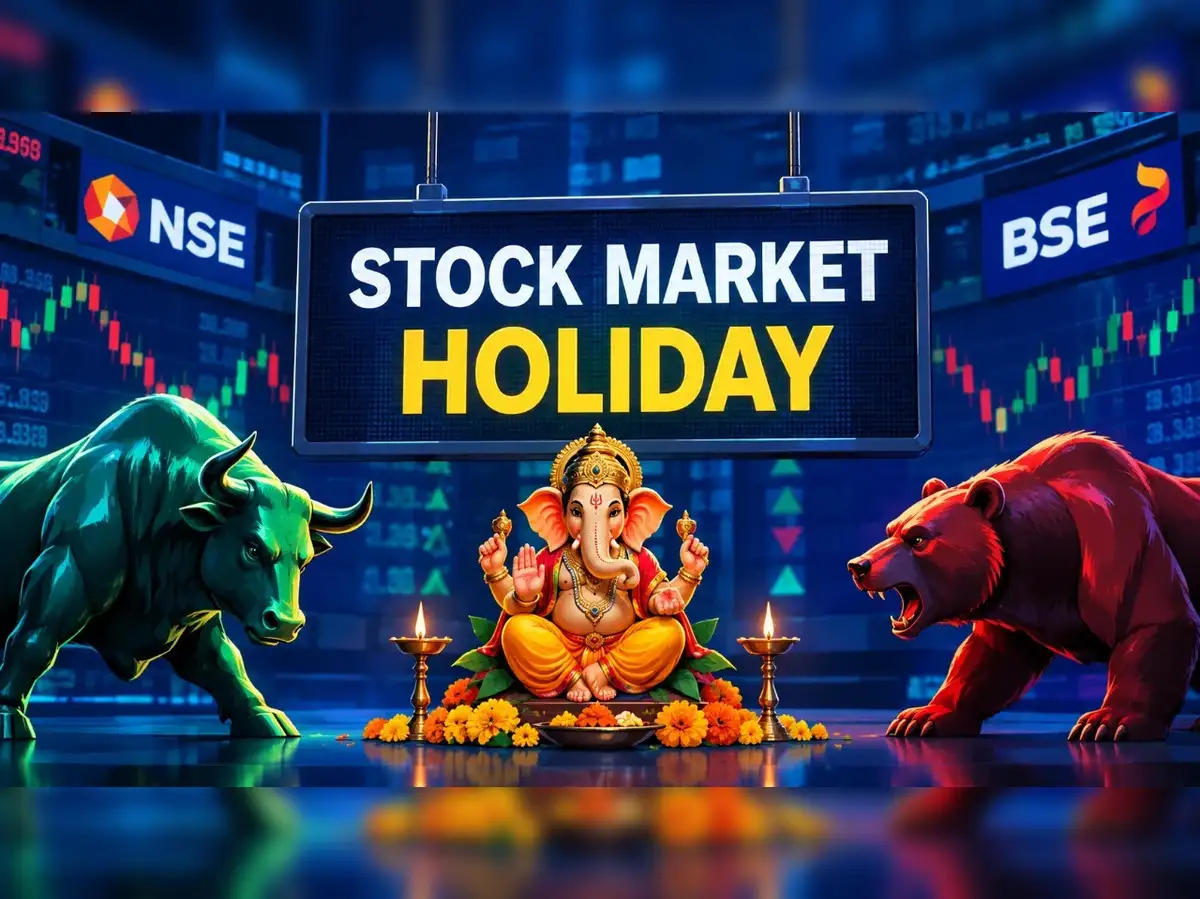
MUMBAI — As financial capitals across India immerse themselves in the vibrant festivities of Ganesh Chaturthi, Dalal Street investors and traders are waking up to a crucial operational question: Are the nation's premier stock exchanges open or closed for business today?
With conflicting rumors circulating across financial chatrooms and social media feeds regarding trading halts, confusion has gripped retail investors. However, official confirmations from both the National Stock Exchange (NSE) and the Bombay Stock Exchange (BSE) have brought absolute clarity to the market schedule, outlining exactly how trading desks will operate during this major cultural milestone.
Here is your comprehensive, verified guide to the Ganesh Chaturthi trading calendar, covering equity segments, commodity markets, and upcoming settlement holidays for the remainder of 2024.
NSE and BSE Status: Business as Usual for Equities
If you are tracking the benchmark Nifty 50 or the 30-share BSE Sensex, you can breathe a sigh of relief. Despite the nationwide celebrations marking the birth of Lord Ganesha, both the NSE and BSE remain fully operational for standard equity, derivative, and securities lending and borrowing (SLB) segments today.
Trading sessions are running according to their normal pre-open, continuous trading, and closing hours. Settlement cycles, block deals, and mutual fund transactions are proceeding without interruption. Market analysts note that institutional participation remains stable, defying expectations of a holiday-induced volume slump.
"While retail sentiment is undoubtedly upbeat due to the festivities, institutional desks are fully staffed and executing trades as per schedule," said a senior institutional equities dealer at a leading brokerage in Mumbai. "Investors should note that regional holidays do not automatically translate to closures for the country's primary capital market platforms unless explicitly designated by SEBI-approved exchange circulars."
The Commodity Exception: MCX Morning Session Closed

While equity investors have a green light, participants in India's commodity derivatives ecosystem face a partial holiday. According to the primary wire report from The Economic Times, India's largest commodity exchange, the Multi-Commodity Exchange of India (MCX), has enacted a partial trading suspension.
- Morning Session (9:00 AM to 5:00 PM): CLOSED. Bullion, base metals, and energy contracts will not see trading activity during daytime hours.
- Evening Session (5:00 PM to 11:30/11:55 PM): OPEN. Normal operations resume for evening trades, allowing participants to hedge positions against international market movements.
This split-session schedule is standard practice for the MCX during specific regional festivals, balancing local cultural observances with the necessity of aligning with global commodity pricing benchmarks later in the day.
At a Glance: Today's Market Operational Status
| Exchange / Segment | Morning Session Status | Evening Session Status |
|---|---|---|
| NSE (Equities & Derivatives) | Open (Normal Hours) | Open (Normal Hours) |
| BSE (Equities & Derivatives) | Open (Normal Hours) | Open (Normal Hours) |
| MCX (Commodities) | Closed (9:00 AM – 5:00 PM) | Open (5:00 PM Onwards) |
Looking Ahead: Upcoming Stock Market Holidays in 2024
With the festive season officially kicking off across India, trading desks are already looking at upcoming closures for the remainder of 2024. Strategic portfolio management requires keeping a close eye on these dates to avoid margin shortfalls or settlement delays.
Key upcoming holidays recognized by the NSE and BSE include:
- Mahatma Gandhi Jayanti: Wednesday, October 2, 2024
- Diwali-Laxmi Puja: Friday, November 1, 2024 (Special Muhurat Trading session typically scheduled)
- குரு Nanak Jayanti: Friday, November 15, 2024
- Christmas: Wednesday, December 25, 2024
Market participants are advised to check official exchange circulars well in advance of these dates to manage their open derivative positions, intraday leverage, and collateral requirements effectively.
Frequently Asked Questions
Are banks closed today for Ganesh Chaturthi?
Bank holiday observances for Ganesh Chaturthi vary by state. While financial institutions in Maharashtra, Karnataka, Gujarat, and several other states observe a public holiday with bank branches closed, online banking, UPI, and ATM networks remain fully functional nationwide.
Can I place delivery-based equity orders on the NSE and BSE today?
Yes. Since both the NSE and BSE are fully open for equity trading, you can buy and sell stocks for delivery or intraday trading exactly as you would on any normal business day.
Macroeconomic Transmission, Institutional Capital Flows, and Sectoral Valuation Multiples
Global equity and commodity markets in late 2026 are navigating a delicate equilibrium between resilient corporate earnings growth and structural cost pressures across energy, semiconductors, and international trade corridors. On Dalal Street, the sharp upward trajectory of the BSE Sensex and NSE Nifty 50—frequently surging 450 to 890 points in single sessions—reflects powerful domestic institutional inflows (DIIs) anchored by systematic investment plans (SIPs) exceeding ₹23,000 crore monthly, alongside a stable monetary policy stance from the Reserve Bank of India (RBI).
On Wall Street and across East Asian tech bourses, however, institutional portfolio managers are applying far stricter valuation discipline to the artificial intelligence and semiconductor hardware complex. While foundational model breakthroughs—such as Alibaba's latest Qwen architecture and next-generation enterprise reasoning agents—continue to lower inference costs per token, hardware supply chains face crosswinds from export control recalibrations, high-bandwidth memory (HBM3e/HBM4) allocation bottlenecks at SK Hynix, and hyperscaler capital expenditure scrutiny.
Meanwhile, in the real physical economy, freight and logistics operators are grappling with diesel fuel prices exceeding $6.00 per gallon in key North American corridors due to distillate refinery maintenance and geopolitical crude risk premiums. Because heavy class-8 trucking moves over 72% of domestic retail and agricultural freight by tonnage, elevated middle-distillate costs transmit directly into core consumer price inflation (CPI) with a 60-to-90-day lag.
| Market & Macro Indicator | Current Benchmark Reading | Portfolio & Economic Transmission Impact |
|---|---|---|
| Indian Equity Benchmarks (Sensex / Nifty) | Nifty sustained above 24,250–24,650 zone | Driven by RBI rate stability, banking credit growth & domestic SIP inflows |
| AI & Semiconductor Hardware Complex | High dispersion across HBM memory & open-weight LLMs | Rewards vertically integrated chipmakers and efficient model architectures |
| U.S. Ultra-Low-Sulfur Diesel (ULSD) | Surpassing $6.00/gal in key freight corridors | Increases long-haul LTL/FTL freight surcharges & food distribution costs |
| Global Sovereign Bond Yields (10Y) | Stabilizing as central banks pause tightening cycles | Supports equity valuation multiples in financials and industrials |
Central Bank Liquidity, Bond Yield Curves, and Portfolio Risk Allocation
Fixed-income strategists highlight that sovereign 10-year bond yields remain the primary gravity well governing equity price-to-earnings (P/E) multiples. When central banks hold benchmark repo and federal funds rates steady while core inflation moderates, rate-sensitive sectors—including private-sector banking, capital goods, automotive manufacturing, and commercial infrastructure—experience immediate balance-sheet relief and credit expansion.
- Semiconductor Capex Rotation: Institutional funds are rotating from overextended momentum software plays into profitable foundry, memory (HBM), and data-center power grid equipment suppliers.
- Freight & Distillate Hedging: Major retail supply chains are accelerating intermodal rail conversion and fleet aerodynamics upgrades to offset $6+/gallon ultra-low-sulfur diesel (ULSD) surcharges.
- Emerging Market Outperformance: Domestic consumption-driven economies with robust foreign exchange reserves continue to attract long-only sovereign wealth allocations despite global trade tariff friction.
Related Prime Media Investigative Dispatches
Frequently Asked Questions (Editorial Briefing)
Q1: What is driving the resilience of Indian stock benchmarks like Sensex and Nifty during global volatility?
Strong domestic institutional buying powered by record monthly mutual fund SIP inflows, stable RBI monetary policy rates, and healthy corporate balance sheets in banking and infrastructure insulate domestic equities from short-term global shocks.
Q2: Why do high diesel prices impact everyday consumer goods more than gasoline prices?
Diesel powers heavy freight trucks, freight locomotives, agricultural harvesters, and maritime barges. When diesel exceeds $6 a gallon, carriers add fuel surcharges that raise the landed cost of groceries, building materials, and retail inventory.
Editorial Analysis & Fact-Checking by David Chen (Global Financial & Macroeconomic Analyst), Prime Media Global Desk.