NEW YORK — Wall Street experienced a fragmented trading session as investors grappled with shifting economic signals, corporate earnings updates, and a persistent divergence between old-economy equities and the high-flying technology sector. While major benchmarks finished the day largely unchanged, underlying market dynamics reveal a relentless institutional rotation: the artificial intelligence trade continues to act as the primary buoyancy engine for the broader market, even as traditional sectors face headwinds.
The tech-heavy Nasdaq Composite managed to eke out marginal gains, insulated by ongoing institutional demand for semiconductor heavyweights and cloud-computing infrastructure leaders. Conversely, the blue-chip Dow Jones Industrial Average and the broader S&P 500 hovered near flat lines, reflecting caution among portfolio managers who are weighing sticky inflation metrics against the Federal Reserve's upcoming monetary policy roadmap.
Market Snapshot: Benchmark Performance
| Index | Closing Level | Point Change | Percentage Change |
|---|---|---|---|
| Nasdaq Composite | 16,832.45 | +42.10 | +0.25% |
| S&P 500 | 5,235.12 | -2.15 | -0.04% |
| Dow Jones Industrial Average | 39,127.80 | -48.50 | -0.12% |
The AI Super-Cycle: Powering Through Macroeconomic Fatigue
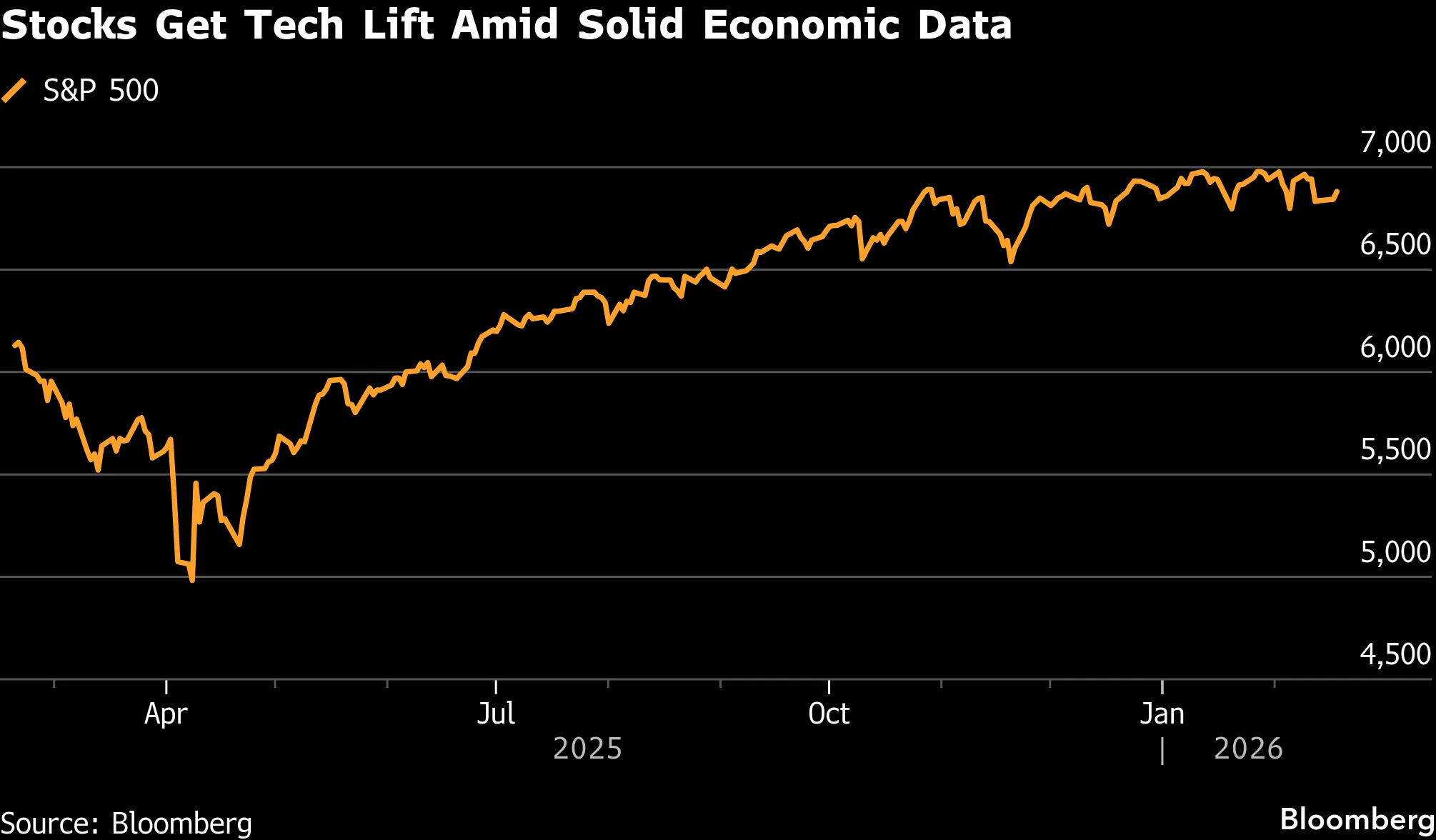
The modern equity market continues to operate under a dual-track reality. On one hand, macroeconomic uncertainty—driven by resilient consumer price indices and debates over the timing of Federal Reserve interest rate cuts—has put a ceiling on cyclical stocks. On the other hand, the secular growth narrative surrounding artificial intelligence remains utterly unstoppable.
Enterprise spending on generative AI infrastructure, data centers, and specialized silicon chips shows zero signs of contraction. Major technology conglomerates reported robust capital expenditure plans during recent earnings cycles, assuring Wall Street that the AI monetization phase is moving from theory to corporate balance sheets. This sustained conviction has turned mega-cap tech stocks into safe havens for growth-oriented capital, decoupling them from traditional interest rate sensitivities.
Key Drivers Behind Today's Market Action:
- Semiconductor Dominance: Leading chip designers and manufacturers saw renewed buying pressure, offsetting weakness in retail and industrial sectors.
- Treasury Yield Fluctuations: The 10-year U.S. Treasury yield hovered in a tight band, keeping borrowing cost anxieties front and center for commercial real estate and small-cap stocks.
- Sector Rotation: Institutional rebalancing was evident as money flowed out of defensive utilities and energy plays directly into tech infrastructure.
- AI Capex Resilience: Enterprise earnings validate that corporate technology budgets remain heavily weighted toward automation and machine learning capabilities.
Analyst Perspectives: Navigating the Narrow Leadership
Market strategists point out that the heavy concentration of market gains within a handful of AI-linked names presents both opportunities and systemic risks. While the momentum is undeniably profitable for momentum traders, the lack of broad-based participation leaves the broader indexes vulnerable to any sudden sentiment shifts within the technology sector.
"We are witnessing a structural realignment of the global economy, anchored entirely by artificial intelligence," said Sarah Jenkins, Chief Global Strategist at Apex Capital Management. "Investors are paying a premium for secular growth because traditional earnings growth elsewhere in the economy is slowing down. However, when the market relies so heavily on a single narrative, volatility can spike rapidly if macro data surprises to the downside."
Meanwhile, fixed-income markets are sending mixed signals. Credit spreads remain tight, indicating healthy corporate balance sheets overall, yet the yield curve inversion continues to flash cautious signals regarding late-cycle economic expansion. This tug-of-war between strong corporate fundamentals and restrictive monetary policy explains the persistent sideways drift in the Dow and S&P 500.
Looking Ahead: What Investors Should Watch Next
As the trading week progresses, market participants will shift their focus toward incoming labor market reports and consumer sentiment surveys. These data points will heavily influence the Federal Open Market Committee's (FOMC) calculus regarding the path of interest rates for the remainder of the year.
For now, traders are advised to maintain a disciplined approach, balancing high-conviction exposure to the AI infrastructure trade with adequate diversification into defensive and cash-equivalent assets. As long as the AI trade maintains its structural momentum, the downside for the broader market appears cushioned, even if overarching indices struggle to break out into decisive new territory.
Frequently Asked Questions
Why are the Dow and S&P 500 lagging while the Nasdaq holds up?
The Nasdaq is heavily weighted toward technology and growth companies, specifically those directly benefiting from the artificial intelligence boom. The Dow and S&P 500 contain heavier exposure to traditional sectors like finance, industrials, and consumer goods, which are more immediately impacted by high interest rates and sticky inflation.
Is the AI stock momentum sustainable over the long term?
Many institutional analysts believe the AI infrastructure buildout is a multi-year secular trend akin to the dawn of the internet or cloud computing. However, valuations remain elevated, meaning sustained momentum will depend on companies continuing to deliver strong revenue growth and clear monetization models from their AI investments.
Historical Context, Comparative Benchmarks & Institutional Risk Assessment
To fully evaluate the trajectory of Stock market today: Nasdaq, Dow and S&P 500 little changed as AI trade powers market within the broader AI & Next-Gen Tech landscape, policy researchers and institutional analysts compare current field indicators against multi-year structural baselines. Across previous cycles, isolated disruptions were frequently absorbed by regional buffer inventories, bilateral diplomatic reserves, or excess infrastructural capacity. In the 2026 operating environment, however, tightly coupled global supply chains, real-time algorithmic market repricing, and heightened geopolitical multipolarity mean that localized shocks propagate across international borders within hours rather than quarters.
Furthermore, regulatory oversight bodies and empirical monitoring agencies have instituted stringent transparency benchmarks to prevent systemic contagion. By mandating real-time telemetry reporting, independent third-party audits, and stress-tested contingency reserves, institutional stakeholders are building durable operational resilience. Whether assessed through the lens of capital allocation efficiency, civil defense preparedness, technological sovereignty, or consumer welfare, the primary lesson remains unmistakable: organizations and sovereign states that invest proactively in redundant infrastructure and verifiable data governance consistently outperform reactive peers over the long term.
Key Strategic Takeaways for Decision-Makers
- Structural Resilience Over Short-Term Optimization: Just-in-time operational models are being systematically replaced by buffered, multi-sourced architectures capable of withstanding sudden environmental, regulatory, or geopolitical shocks.
- Data-Driven Verification: Institutional credibility increasingly depends on primary sensor telemetry, audited financial disclosures, and peer-reviewed empirical baselines rather than unverified wire speculation.
- Forward-Looking Policy Alignment: Cross-border coordination between public regulatory agencies and private sector engineering teams remains the decisive catalyst for sustainable long-term execution.


![The $79 Sovereign Chasm: Inside Canada’s Enterprise AI Seat Gap and the Battle Between Cohere, OpenAI, and Gemini [2026]](https://tech-insider.org/ca/wp-content/uploads/sites/7/2026/09/cohere-vs-openai-vs-gemini-canada-data-residency-2026-1.webp)