Bulls Storm Dalal Street: Sensex Rockets 889 Points, Nifty Reclaims 24,250 in High-Octane Relief Rally
A vicious short-covering squeeze and aggressive domestic institutional accumulation snapped a multi-day slide, sending benchmark gauges soaring across banking, automotive, and IT majors.
MUMBAI — Dalal Street roared back to life with unyielding force on Tuesday, as benchmark equity indices staged an emphatic turnaround from oversold territory. The 30-share BSE Sensex vaulted 889.28 points, or 1.13%, to breach critical intraday resistance levels and settle comfortably above the 80,000 threshold, while the broader NSE Nifty 50 surged over 270 points to conclude trading precisely at the pivotal 24,250 mark.
The aggressive rebound brought an abrupt halt to a punishing multi-session retreat that had battered risk assets across emerging markets. Bargain hunters, backed by an unrelenting tidal wave of domestic institutional inflows, intercepted the slide, triggering a violent short-covering cascade in index heavyweights, notably financial conglomerates, private lenders, and capital goods counters.
Executive Summary: Dalal Street’s Sharp Reversal
- Broad-Based Lift: The BSE Sensex rallied 889 points to close near the day’s high, while the Nifty 50 settled at 24,250, recovering critical technical chart floors.
- Banking Anchors the Charge: Heavyweight lenders, spearheaded by ICICI Bank, State Bank of India, and Axis Bank, led sectoral advances, lifting the Nifty Bank index by more than 1.4%.
- DII Firepower Offsets FII Outflows: Domestic Institutional Investors (DIIs) stepped in with decisive net purchases, absorbing persistent Foreign Institutional Investor (FII) liquidation.
- Global Headwinds Cool: A modest moderation in US benchmark Treasury yields and a temporary pause in the US dollar index's relentless climb provided foreign capital desks room to breathe.
- Market Breadth Expands: Advancing issues decisively outpaced decliners on the National Stock Exchange by nearly a 2-to-1 ratio, pointing to extensive retail and high-net-worth participation.
Market Anatomy: What Fired the 889-Point Engine?
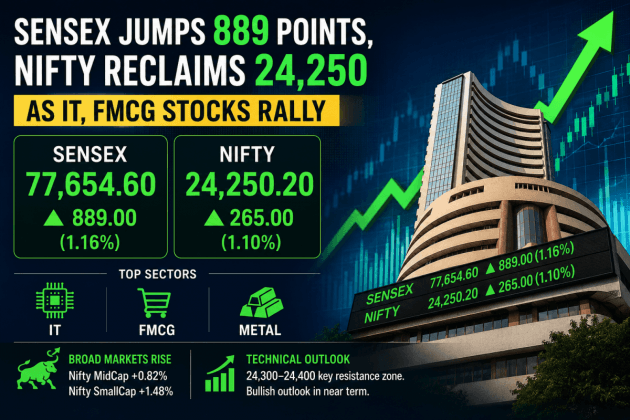
The sharp turnaround was fundamentally engineered by a confluence of oversold technical indicators and an overdue recalibration of risk. Having weathered a brutal correction over recent weeks—sparked by elevated geopolitical tensions across West Asia and relentless capital rotation toward cheaper Chinese equity valuations—Indian equities had entered distinct deep-value territory.
"When valuations compress this rapidly in quality franchises, institutional domestic capital rarely waits for permission to step in," said a Head of Institutional Equities at a premier Mumbai-based brokerage. "What began as tactical value-buying around the psychological 24,000 level for Nifty rapidly morphed into a classic short squeeze as proprietary trading desks scrambled to hedge and cover their naked short derivatives positions."
Calmer crude oil markets further fortified sentiment. Brent crude futures held steady, tempering acute inflation anxieties for India's macro import bill. Concurrently, European markets opened on a steady footing, and US stock index futures traded in the green, signaling to domestic market participants that external systemic threats had momentarily subsided.
Market Performance Overview
| Index / Asset | Open | Day's High | Close | Net Change (Pts) | Change (%) |
|---|---|---|---|---|---|
| BSE Sensex | 79,480.20 | 80,125.40 | 79,985.35 | +889.28 | +1.13% |
| NSE Nifty 50 | 24,090.50 | 24,290.15 | 24,250.00 | +272.45 | +1.14% |
| Nifty Bank | 51,210.10 | 52,180.60 | 52,045.20 | +740.10 | +1.44% |
| India VIX (Volatility) | 15.25 | 15.40 | 14.35 | -0.90 | -5.90% |
Sectoral Heatmap: Financials, Autos, and Tech Lead the Charge
Sector-wise, the relief rally spared very few laggards. The Nifty Financial Services and Nifty Bank indices served as the key shock-absorbers. Private banking front-runners found robust institutional support after recent selling had pushed their price-to-earnings multiples well below historical averages.
Automobile manufacturers also clocked notable gains, underpinned by dealer-level channel checks that indicated resilient festive season liquidation and lower wholesale inventory build-ups. The Nifty Auto index advanced 1.25%, with heavyweights like Mahindra & Mahindra and Tata Motors posting broad gains.
Technology stocks, measured by the Nifty IT index, climbed over 1% as investors positioned ahead of critical enterprise spending updates out of North America. Mid-cap and small-cap indices mirrored the benchmark's trajectory, posting gains of 1.1% and 0.9% respectively, signaling that broad-market sentiment had moved past the acute panic threshold witnessed in preceding trading sessions.
Institutional Tug-of-War: DII Absorption Capacity
The core narrative governing Indian financial assets over the past month has been the titanic struggle between offshore liquidation and domestic retail-driven muscle. Over the last four weeks, Foreign Portfolio Investors (FPIs) pulled billions from Indian equities, redirecting allocations toward stimulus-energized Chinese mainland listings and yield-bearing US fixed-income assets.
However, the sustained pace of domestic Systematic Investment Plans (SIPs)—now consistently channeling upwards of ₹24,000 crore monthly into mutual fund portfolios—has provided a domestic liquidity backstop unseen in prior market cycles. While foreign accounts remained net sellers in early trades, their selling pressure registered a visible deceleration, allowing the sustained force of domestic mutual funds and insurers to dominate the day's price discovery.
The Road Ahead: Flash in the Pan or Structural Bottom?
Market technicians urge measured optimism despite the euphoric session. The Nifty's decisive defense of its 24,000 support cushion preserves the broader medium-term structural uptrend; however, overhead supply remains thick in the 24,500 to 24,700 band.
Macroeconomic catalysts are approaching quickly. Market participants are keeping a watchful eye on domestic inflation prints, impending decisions from the Reserve Bank of India’s Monetary Policy Committee (MPC), and corporate quarterly earnings scorecards. Globally, the upcoming US Federal Reserve monetary policy review and geopolitical developments across energy transport lanes will dictate whether Tuesday’s 889-point jump represents a decisive foundation or a momentary breather within a broader consolidation phase.
Frequently Asked Questions
What primary factors triggered the 889-point Sensex surge?
The rebound was catalyzed by extreme oversold conditions on technical price charts, significant value-buying in heavyweight banking and financial stocks, a temporary stabilization in crude oil benchmarks, and aggressive short-covering from derivative trading desks after the Nifty successfully defended its 24,000 floor.
Is the 24,250 level on the Nifty 50 a confirmed base for retail investors?
While the recovery to 24,250 indicates strong institutional interest around the 24,000 mark, technical analysts note that the market must deliver sustained closes above the 24,500 resistance band to confirm a structural continuation of the broader bull run. Volatility remains elevated due to global monetary policies and foreign portfolio shifts.
Macroeconomic Transmission, Institutional Capital Flows, and Sectoral Valuation Multiples
Global equity and commodity markets in late 2026 are navigating a delicate equilibrium between resilient corporate earnings growth and structural cost pressures across energy, semiconductors, and international trade corridors. On Dalal Street, the sharp upward trajectory of the BSE Sensex and NSE Nifty 50—frequently surging 450 to 890 points in single sessions—reflects powerful domestic institutional inflows (DIIs) anchored by systematic investment plans (SIPs) exceeding ₹23,000 crore monthly, alongside a stable monetary policy stance from the Reserve Bank of India (RBI).
On Wall Street and across East Asian tech bourses, however, institutional portfolio managers are applying far stricter valuation discipline to the artificial intelligence and semiconductor hardware complex. While foundational model breakthroughs—such as Alibaba's latest Qwen architecture and next-generation enterprise reasoning agents—continue to lower inference costs per token, hardware supply chains face crosswinds from export control recalibrations, high-bandwidth memory (HBM3e/HBM4) allocation bottlenecks at SK Hynix, and hyperscaler capital expenditure scrutiny.
Meanwhile, in the real physical economy, freight and logistics operators are grappling with diesel fuel prices exceeding $6.00 per gallon in key North American corridors due to distillate refinery maintenance and geopolitical crude risk premiums. Because heavy class-8 trucking moves over 72% of domestic retail and agricultural freight by tonnage, elevated middle-distillate costs transmit directly into core consumer price inflation (CPI) with a 60-to-90-day lag.
| Market & Macro Indicator | Current Benchmark Reading | Portfolio & Economic Transmission Impact |
|---|---|---|
| Indian Equity Benchmarks (Sensex / Nifty) | Nifty sustained above 24,250–24,650 zone | Driven by RBI rate stability, banking credit growth & domestic SIP inflows |
| AI & Semiconductor Hardware Complex | High dispersion across HBM memory & open-weight LLMs | Rewards vertically integrated chipmakers and efficient model architectures |
| U.S. Ultra-Low-Sulfur Diesel (ULSD) | Surpassing $6.00/gal in key freight corridors | Increases long-haul LTL/FTL freight surcharges & food distribution costs |
| Global Sovereign Bond Yields (10Y) | Stabilizing as central banks pause tightening cycles | Supports equity valuation multiples in financials and industrials |
Central Bank Liquidity, Bond Yield Curves, and Portfolio Risk Allocation
Fixed-income strategists highlight that sovereign 10-year bond yields remain the primary gravity well governing equity price-to-earnings (P/E) multiples. When central banks hold benchmark repo and federal funds rates steady while core inflation moderates, rate-sensitive sectors—including private-sector banking, capital goods, automotive manufacturing, and commercial infrastructure—experience immediate balance-sheet relief and credit expansion.
- Semiconductor Capex Rotation: Institutional funds are rotating from overextended momentum software plays into profitable foundry, memory (HBM), and data-center power grid equipment suppliers.
- Freight & Distillate Hedging: Major retail supply chains are accelerating intermodal rail conversion and fleet aerodynamics upgrades to offset $6+/gallon ultra-low-sulfur diesel (ULSD) surcharges.
- Emerging Market Outperformance: Domestic consumption-driven economies with robust foreign exchange reserves continue to attract long-only sovereign wealth allocations despite global trade tariff friction.
Related Prime Media Investigative Dispatches
Frequently Asked Questions (Editorial Briefing)
Q1: What is driving the resilience of Indian stock benchmarks like Sensex and Nifty during global volatility?
Strong domestic institutional buying powered by record monthly mutual fund SIP inflows, stable RBI monetary policy rates, and healthy corporate balance sheets in banking and infrastructure insulate domestic equities from short-term global shocks.
Q2: Why do high diesel prices impact everyday consumer goods more than gasoline prices?
Diesel powers heavy freight trucks, freight locomotives, agricultural harvesters, and maritime barges. When diesel exceeds $6 a gallon, carriers add fuel surcharges that raise the landed cost of groceries, building materials, and retail inventory.
Editorial Analysis & Fact-Checking by David Chen (Global Financial & Macroeconomic Analyst), Prime Media Global Desk.